


Varenummer: 647100
How to Grow Bismuth Crystals

What is needed?
For this process, you need a sufficiently wide and deep melting vessel as well as another similar sized vessel. In addition, you need pure bismuth with a purity of 3-4N, an energy source (e.g. gas burner or electric oven), tongs or tweezers, a butter knife, spoon or similar for removing the scabies and ideally a steel wire or rod for vaccinating the melt.
The size of your crystals depends on various factors, including the purity of the bismuth (recommended 3-4N), the volume of the melting bath, the geometry of the melting vessel (minimum surface area in relation to volume) and the cooling speed. In addition, the targeted insertion of solid, cooling wires or rods can accelerate the crystallization process and makes cooling from “inside out” possible.

Step 1:
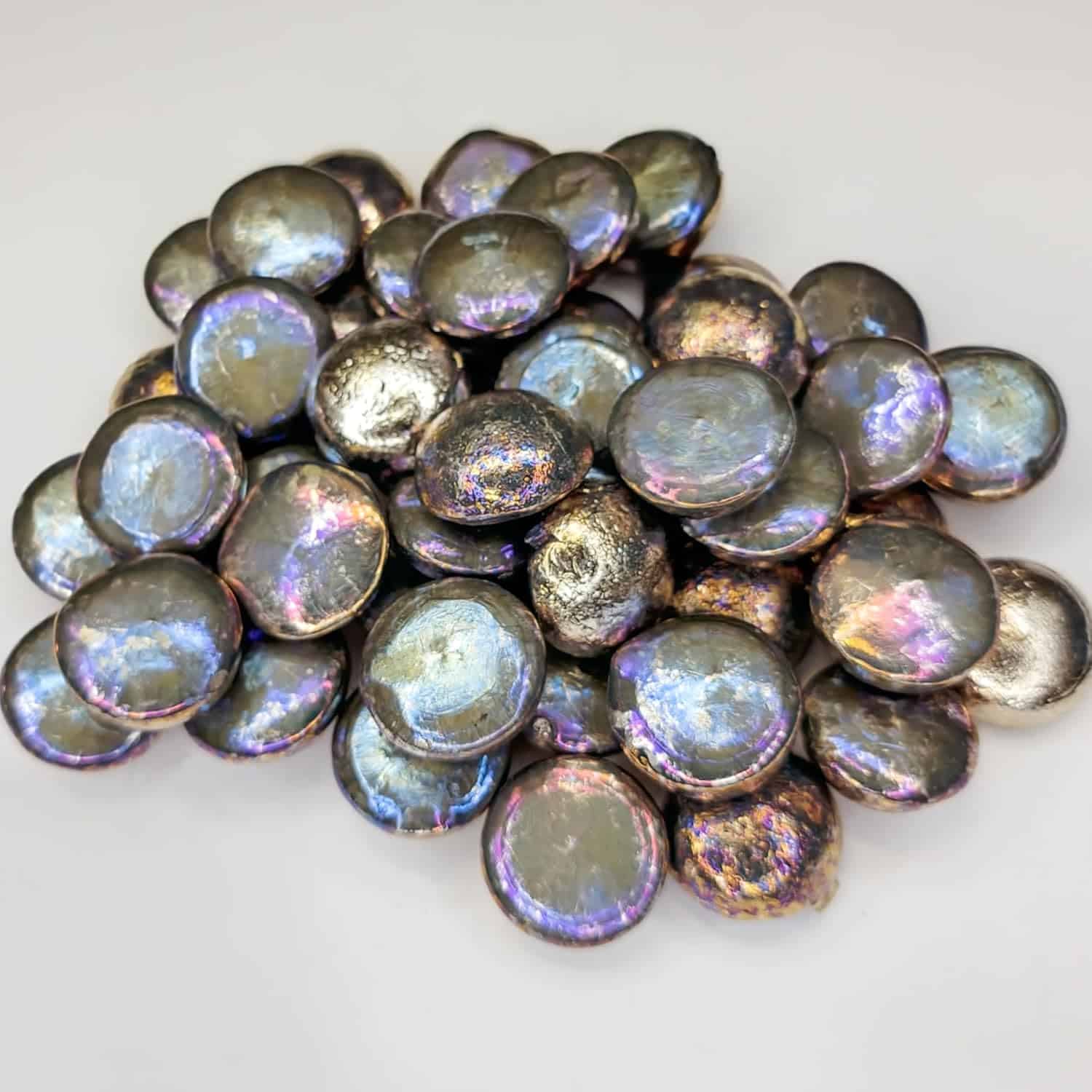
Fill the melting vessel with sufficient bismuth, preferably in the form of pellets or fragments. It should be relatively full when all bismuth has melted.

Step 2:
Now melt the bismuth with a suitable energy source, be it electric or gas heated. Depending on the size of the melting vessel and the amount of bismuth, different heating units can be used. In this example, a slightly larger camping gas stove was used.

Step 3
If you have used coarse bismuth fragments, you can add more pieces during melting. Make sure they are free from moisture to avoid explosions when immersion.

Step 4
If all the bismuth is liquid, turn off or lower the energy source so that a (slow) cooling of the bismuth can occur. Slow cooling promotes the formation of larger crystals.

Step 5
Now remove the oxides (scabies) from the bath surface.

Step 6
Then hold the wire or rod (optionally pre-cooled) in the middle of the bath surface and fix it. This should also be free from moisture. Make sure that it does not reach the bottom of the melting vessel to avoid growing. If you don’t want to use a wire or rod, you can skip this step.

Step 7
Now wait until the melt has solidified so far that you can use the wire or rod can just be removed relatively well. At this time, the largest crystals should have formed on the wire or rod. Without the wire or rod inserted, you can use the tweezers to pull out the resulting crystals from the bath surface. The colour of the crystals can be “preserved” by quenching in water at lighter levels.

Step 8
Pour the residual melt from the melting vessel to extract more crystals from the walls.

Step 9
Demould the solid bismuth quickly, otherwise it may wedge in the container. Bismuth expands when solidified and becomes harder to demould the longer you wait.

Step 10
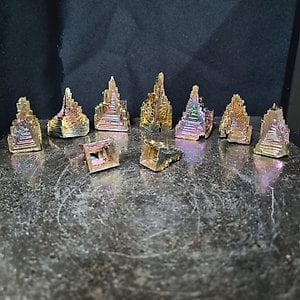
By breaking the demoulded bismuth “bowls” you can gain more crystals. All crystals and residues you do not want to keep can be easily melted back into place.

Why does it make sense to “vaccinate” the melt
From the moment you initiate the cooling process, the bismuth begins to solidify in the places where so-called germs can best form. A germ can only arise (without disintegrating immediately) if the temperature in the melt falls below a critical value. Therefore, germ formation preferably occurs at the edges and the bath surface, where a lot of energy is dissipated. Due to this effect, solidification occurs from the outside to the inside and not vice versa.
If you now insert a solid object with relatively good thermal conductivity (as most metals have) into the middle of the melting bath, you will provoke solidification there, which is usually only observed at the edges. This allows you to achieve partial cooling from the inside.
We recommend a steel wire, as it is largely excluded that foreign atoms of the steel contaminate the bismuth. In principle, you can also use copper or aluminium.


