

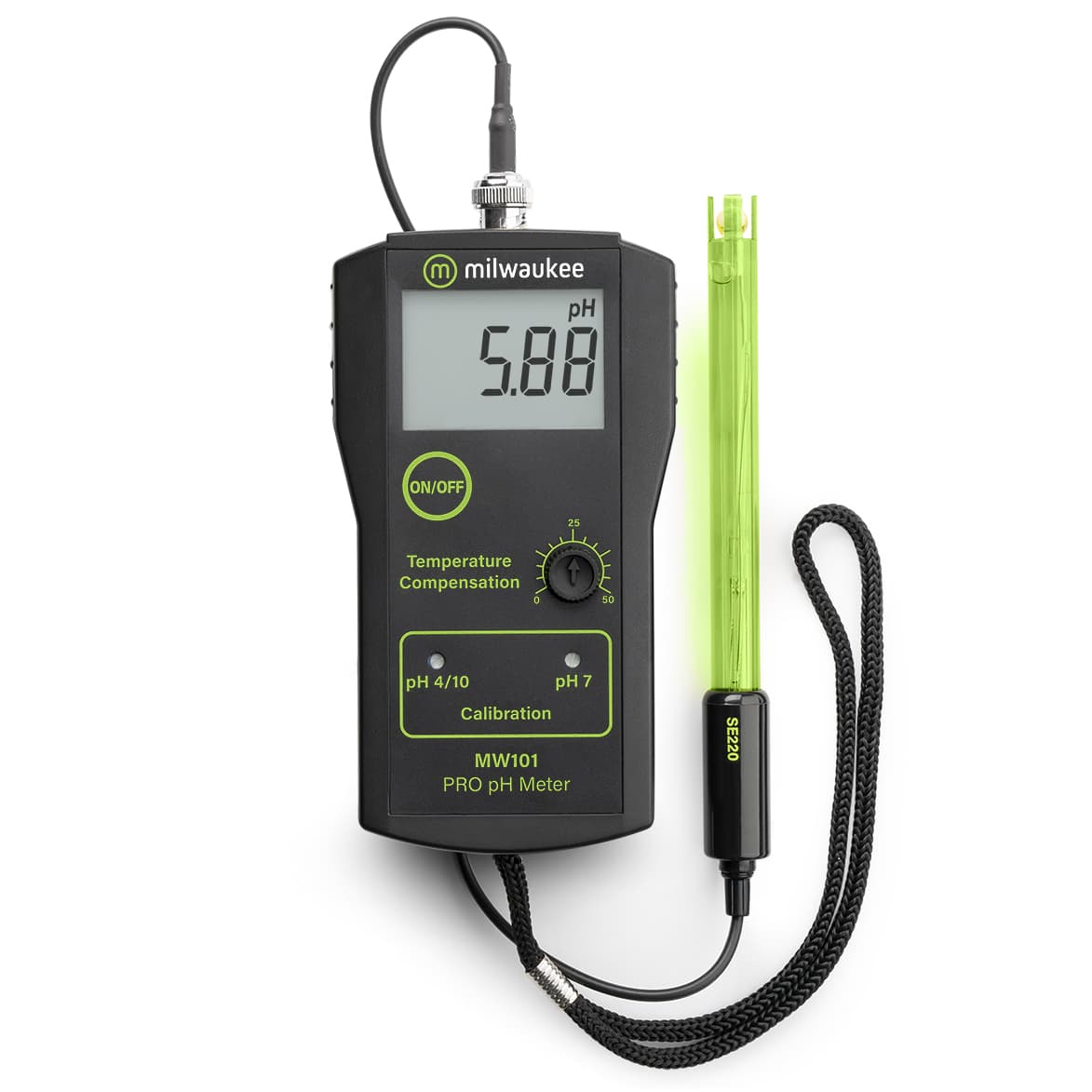


Varenr.: 440120
pH-område: 0,00 til 14,00 pH
pH Opløsning: 0,01 pH
pH-nøjagtighed: ±0,02 pH
Temperaturkompensation: Manuel, 0 til 50°C
Kalibrering: Manuel, i 2 punkter gennem offset- og hældningstrimmer
pH-elektrode: MA920B/1 med ca. 1 meter kabel (medfølger)
Arbejdsområde: 0 til 50°C, max RH 95 %
Batteritype: 1 x 9V (inkluderet)
Batterilevetid: Ca. 300 timers kontinuerlig brug
Dimensioner: ca. 15 x 8 x 4 cm
Vægt: ca. 220 gram (med batteri)
Application
Hydroponics & Agriculture
In both hydroponic systems and traditional soil-based agriculture, pH plays a critical role in nutrient absorption and overall plant vitality. If the pH of your water or nutrient solution drifts outside the optimal range, essential nutrients like nitrogen, phosphorus, and potassium can become chemically locked out – unavailable to your plants no matter how much you feed them.
This is where the Milwaukee MW101 PRO pH Meter becomes an indispensable tool. Designed for precision, portability, and ease of use, the MW101 PRO allows growers to monitor and adjust pH levels quickly, helping prevent nutrient deficiencies, promote healthy root systems, and increase yields. Whether you’re managing a commercial hydroponic greenhouse or cultivating a home garden, maintaining the correct pH ensures that your plants get the full benefit of your feeding schedule.
Why It Matters:
- In hydroponics, optimal pH typically ranges between 5.5–6.5. Falling outside this window can hinder uptake of key elements.
- In soil, slightly higher pH levels (6.0–7.0) are generally acceptable, but excessive acidity or alkalinity can disrupt the soil microbiome and nutrient availability.
- Daily pH checks with a meter like the MW101 PRO help identify problems early, before they impact crop performance or cause irreversible damage.
How to Use the MW101 PRO for Hydroponics & Agriculture:
- Prepare Your Equipment
- Ensure the MW101 PRO is calibrated with pH 7.01 and pH 4.01 (or pH 10.01, depending on your needs) buffer solutions.
- Rinse the MA911B/1 pH electrode with distilled water to remove residue from previous tests.
- Collect a Sample
- For hydroponics: Take a sample of your nutrient solution from the reservoir or directly measure in the tank.
- For soil: Mix your soil sample with distilled water in a 1:1 or 1:2 ratio (soil to water). Let it settle for a few minutes before measuring.
- Immerse the Electrode
- Submerge the pH probe into the solution (or soil slurry) deep enough to fully cover the glass bulb and junction.
- Gently stir or swirl the probe for a few seconds to stabilize the reading.
- Read the Result
- The MW101 PRO’s clear LCD display will show a stable pH reading within seconds.
- If the reading is outside the optimal range for your crops, adjust your nutrient solution or soil treatment accordingly.
- Clean and Store
- After each use, rinse the electrode with distilled water.
- Store the probe in electrode storage solution or pH 4.01 buffer to keep it hydrated and prolong its life.
- Routine Maintenance
- Calibrate regularly – especially before critical measurements or if readings seem inconsistent.
- Replace the electrode when response times slow significantly, or readings become difficult to stabilize.
By integrating the MW101 PRO into your daily growing routine, you’re not just monitoring pH – you’re managing plant performance, protecting your investment, and driving better results season after season. It’s the go-to tool for anyone serious about healthy, high-yield growing.
Swimming Pools & Aquariums
Accurate pH control is one of the most important aspects of maintaining water quality in both swimming pools and aquariums. Unbalanced pH can lead to discomfort, equipment damage, and serious health issues for humans and aquatic life alike. The Milwaukee MW101 PRO pH Meter is your trusted tool for reliable, fast, and precise pH readings, helping you maintain a safe and stable aquatic environment – whether it’s a backyard pool, a vibrant reef tank, or a large-scale aquaculture system.
Why pH Matters:
In Swimming Pools: Ideal pH ranges between 7.2 and 7.8. If the pH is too low (acidic), water can irritate the skin and eyes and corrode pool equipment. If it’s too high (alkaline), chlorine becomes less effective, and the water can become cloudy or lead to scaling.
In Aquariums: Each type of aquarium (freshwater, saltwater, reef) requires specific pH conditions. Freshwater fish often thrive in a pH of 6.5–7.5, while saltwater and reef systems may require 7.8–8.4. Fluctuating or incorrect pH can stress or even kill fish, coral, and beneficial bacteria.
The MW101 PRO provides high-accuracy readings (±0.02 pH), making it ideal for hobbyists and professionals alike who need dependable results to maintain the health and balance of their aquatic systems. Unlike test strips or color-based kits, which can be subjective or inconsistent, the MW101 PRO offers clear, immediate digital readouts you can trust.
How to Use the MW101 PRO for Swimming Pools & Aquariums:
- Calibrate the Meter
- Before use, calibrate the MW101 PRO using pH 7.01 and pH 4.01 or 10.01 buffer solutions, depending on your target range.
- Follow the manual calibration process for maximum accuracy.
- Rinse the Electrode
Use distilled water to rinse the MA911B/1 pH electrode and gently blot dry with a lint-free tissue.
- Collect the Water Sample
- For pools, take a sample from elbow depth or measure directly at the poolside.
- For aquariums, take a water sample from mid-tank depth, away from filter output or air stones to avoid turbulence.
- Insert the Electrode
- Immerse the pH probe fully into the sample, ensuring the bulb and junction are submerged.
- Stir gently for a few seconds and wait for the reading to stabilize.
- Read the Display
The MW101 PRO will show the pH value on its large LCD screen. Compare the result with your target range and adjust the water chemistry as needed (e.g., adding pH increaser, reducer, or buffering agents).
- Post-Use Care
- Rinse the electrode with distilled water again.
- Store the probe in pH storage solution to keep the glass membrane hydrated and functional.
- Routine Tips
- Pools: Check pH daily, especially during hot weather or heavy use.
- Aquariums: Test at consistent times each day and monitor for sudden changes that could stress your fish or corals.
- Clean the probe regularly if you’re working in saltwater or environments with high organic content.
By incorporating the MW101 PRO pH Meter into your pool maintenance or aquarium care routine, you’re investing in clarity, comfort, and aquatic health. No guesswork, no color charts – just fast, accurate results that help you keep your water in perfect balance.
Brewing & Winemaking
In the worlds of craft brewing and artisan winemaking, precision is everything—and pH is one of the most vital parameters to monitor. Whether you’re a home brewer perfecting your IPA or a professional vintner managing a vineyard harvest, pH directly influences fermentation activity, microbial stability, flavor development, and product shelf life.
The Milwaukee MW101 PRO pH Meter is a trusted tool among brewers and winemakers who demand accurate, fast, and consistent pH measurements at every stage of production. From mash to bottle, this portable lab-grade meter helps you fine-tune your process for exceptional quality and repeatable results.
Why pH Control Is Essential:
In Brewing:
- During the mash, ideal pH ranges from 5.2 to 5.6 to optimize enzyme activity for sugar conversion.
- In the boil, monitoring pH can impact hop utilization and final bitterness.
- During fermentation, proper pH levels (around 4.2–4.6) help create a clean, stable environment for yeast.
In Winemaking:
- Juice pH affects color, microbial stability, and taste. A typical target is 3.2–3.6 depending on the grape variety.
- Post-fermentation pH influences mouthfeel and how the wine ages over time.
- pH also plays a crucial role in SO₂ effectiveness and bacterial inhibition.
Unlike test strips, which can be inaccurate or difficult to interpret in colored samples, the MW101 PRO gives clear, digital readouts with high accuracy (±0.02 pH), helping you respond quickly to critical changes and fine-tune your production for superior quality.
How to Use the MW101 PRO for Brewing & Winemaking:
- Calibrate Before Use
- Calibrate the meter using fresh pH 7.01 and 4.01 buffer solutions (or pH 10.01 for higher-range checks).
- Follow the two-point manual calibration steps outlined in the manual for optimal accuracy.
- Prepare the Sample
- For brewing, take a sample from the mash, wort, or fermenting beer. Allow hot samples to cool to room temperature to avoid damaging the probe and getting skewed results.
- For winemaking, collect juice or wine at the desired processing stage, making sure it’s free of solids or large bubbles.
- Rinse and Immerse the Electrode
- Rinse the MA911B/1 pH electrode with distilled water to avoid cross-contamination.
- Submerge the probe into the sample until the glass bulb and junction are completely covered.
- Stir gently for a few seconds to help stabilize the reading.
- Take the Reading
- Watch the MW101 PRO’s large LCD display. Readings will stabilize quickly – typically within seconds.
- Record your result and compare it with your target range to determine if adjustments (e.g., acid additions, mineral salts, pH stabilizers) are needed.
- Post-Use Care
- After use, rinse the electrode thoroughly with distilled water.
- Store it in pH electrode storage solution to maintain hydration and prolong probe life.
- Tips for Consistent Results
- Always test samples at consistent temperatures or correct for temperature variation when necessary.
- Calibrate the meter regularly, especially before production runs.
- Clean the probe after sticky or high-sugar samples to prevent residue build-up.
Whether you’re brewing a crisp pilsner, fermenting a bold red, or exploring new craft styles, the Milwaukee MW101 PRO helps you maintain tight pH control – unlocking greater consistency, quality, and flavor in every batch.
Educational Laboratories
In educational settings – whether secondary schools, technical colleges, or university laboratories – precision, simplicity, and durability are key when teaching scientific principles. The Milwaukee MW101 PRO pH Meter is a trusted choice for educators and lab technicians looking to demonstrate pH measurement fundamentals in a way that is both accurate and easy for students to understand.
With its user-friendly design, high accuracy (±0.02 pH), and manual two-point calibration, the MW101 PRO introduces students to professional-grade instrumentation while remaining accessible for beginners. Whether in general science labs, chemistry, biology, or environmental science courses, this portable pH meter allows students to confidently explore the science of acidity, alkalinity, and water chemistry with reliable results every time.
Why It’s Ideal for Educational Use:
- Hands-on Learning: Reinforces the scientific method with real data collection and analysis.
- Teaches Best Practices: Students learn proper sampling, electrode care, and calibration techniques.
- Encourages Inquiry-Based Experiments: From testing household liquids to analyzing soil and water samples, the MW101 PRO is versatile for a wide range of experiments.
- Built to Last: Durable, lab-ready construction ensures it can withstand frequent use by multiple users across semesters.
By equipping classrooms and teaching labs with the MW101 PRO, institutions can offer students a realistic and professional introduction to water quality testing, analytical instrumentation, and pH dynamics across multiple disciplines.
How to Use the MW101 PRO in Educational Labs:
- Introduce the Components
- Familiarize students with the pH meter, including the MA911B/1 pH electrode, calibration knobs, LCD display, and battery compartment.
- Review basic safety procedures and proper probe handling.
- Calibration Procedure
- Perform a two-point calibration using pH 7.01 and pH 4.01 (or 10.01) buffer solutions.
- Explain the importance of calibration and how it ensures measurement accuracy.
- Demonstrate how to adjust the calibration knobs to match the buffer values.
- Sample Collection
- Guide students in collecting liquid samples: household substances, tap water, juice, vinegar, soil-water mixtures, or pond samples.
- Encourage the use of clean containers and labeling for experimental clarity.
- Rinse the Electrode
- Before testing each sample, rinse the electrode with distilled water and gently blot dry with a lint-free tissue to prevent contamination.
- Measurement Process
- Immerse the probe into the sample, ensuring full submersion of the glass bulb and junction.
- Stir gently and wait for the pH value on the display to stabilize.
- Have students record the reading and repeat with other samples to compare pH values.
- Interpret the Results
- Use the data collected to chart acidity/alkalinity across various substances.
- Connect pH results to real-world applications in environmental science, food chemistry, or biological systems.
- Post-Use Maintenance
- After testing, instruct students to rinse the electrode thoroughly.
- Store the probe in the appropriate storage solution to ensure longevity.
- Reinforce proper equipment care as part of good laboratory practice.
Example Classroom Activities:
- pH of Local Water Sources: Compare pH from bottled water, tap water, and natural sources.
- Acids and Bases Around the House: Analyze pH of lemon juice, soap, milk, and cleaning products.
- Soil Science: Measure pH in soil slurries to discuss plant health and nutrient uptake.
- Food Chemistry: Test acidity in beverages like orange juice, soda, or vinegar.
With the Milwaukee MW101 PRO, educators can bring textbook science to life, giving students the tools to ask questions, explore hypotheses, and gain confidence in lab skills that serve them far beyond the classroom.


